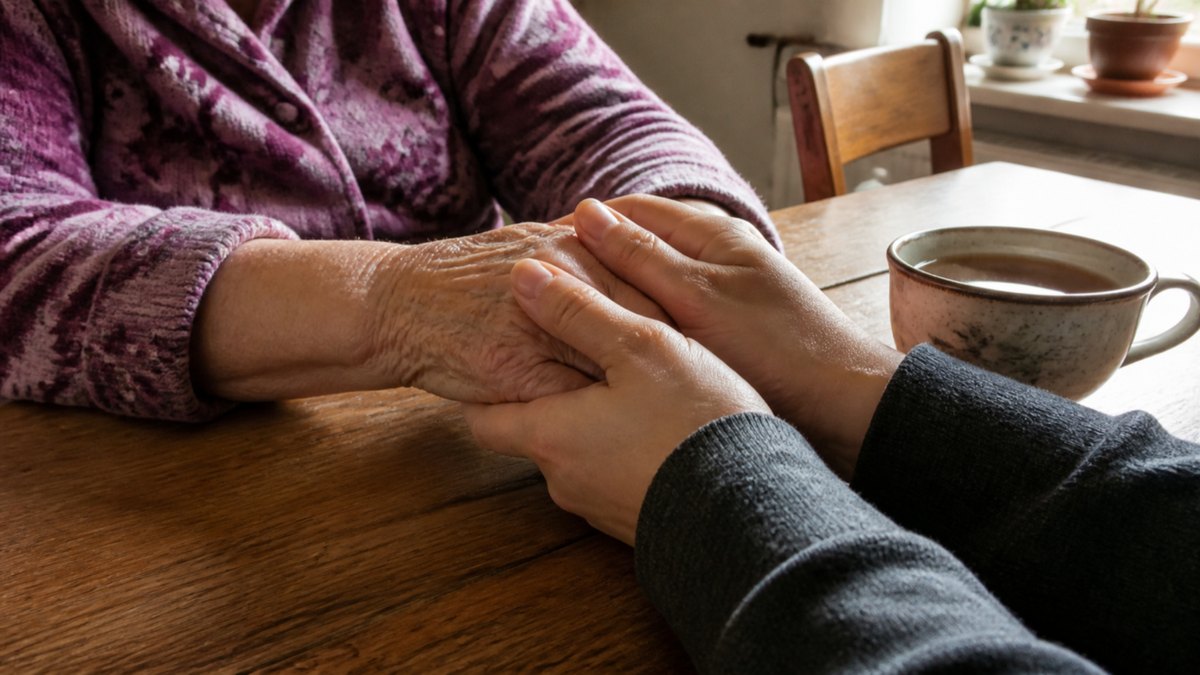
Selflessness is not sacrificing yourself until you disappear. The brain has a brake for stress, and that brake is the bond. But it has a limit, and pride decides how far it reaches.
By Isabella Becker · 14 min read
English edition of Isabella Becker’s Portuguese essay, adapted for international readers. The article presents Virtology’s interpretation; its specific theoretical mechanisms should be distinguished from independently established clinical findings.
It is eleven at night and the doorbell rings. It is the neighbor from the floor below, in slippers, with her son in her arms. A fever of almost 103, her husband away on a trip, the car at the mechanic’s.
You were already in pajamas. The day had been long, your back hurt, your head was halfway to the pillow. You grab the car keys without a second thought.
At two in the morning, driving back from the emergency room, the boy is asleep in the back seat. You should be wrecked. You are not. You drive slowly down the empty street and notice something strange: you are calmer than you were at eleven, before the doorbell rang.
That state has an explanation. And the explanation helps make sense of a virtue that almost everyone gets wrong.
Few people connect these things, but the signs are part of ordinary life:
The calm after helping. You left home reluctantly to bring soup to a sick friend, and came back lighter than you went.
The tiredness that does not weigh. Two hours helping your sister move tire the body in a different way from two hours in a pointless meeting.
The bad week that improves when someone needs you. The problem is still there, but its volume goes down.
The opposite, too. The person who has been caring for a sick mother for three years, alone, with no break, and who feels no calm at all. Only an exhaustion that a night’s sleep does not fix.
Generosity with an address. Someone who does everything for their family and will not lift a finger for anyone outside it. And who sincerely sees themselves as a generous person.
All five items describe the same system. The last two show where it fails.
Selflessness is not sacrifice
In Eduardo Casarotto’s Virtology, Selflessness (in Portuguese, Abnegação) is the virtue that works on selfishness. The summary fits into two questions. What is selfishness? Me first. What is Selflessness? The other first.
The word comes from the Latin for renouncing one’s own will. That is why so many people confuse it with sacrifice. The image that comes to mind is of someone who erases themselves, puts up with everything, never thinks of themselves. That image is wrong, and Virtology itself takes it apart.
Three things look like selflessness and are not. The first is submission: someone who swallows abuse for fear of losing their livelihood or affection is not serving, they are surviving. The second is the sacrifice that sends a bill: “I gave up everything for you, now you owe me.” Giving that comes with an invoice was never giving. The third is renunciation on display, the sacrifice made in order to be seen sacrificing.
What remains when all three leave the stage is free renunciation. It is done without fear, without a bill and without an audience, by someone who could have chosen otherwise.
Giving that comes with an invoice was never giving.
And free renunciation has a property that selfishness cannot see. It does not leave the person poorer. It leaves them more whole. Casarotto puts it in one sentence:
“Caring for the whole gives the brain more pleasure than caring for oneself.” — Eduardo Casarotto
Research supports part of that sentence. In 2006, Jorge Moll and colleagues found that donating to a cause activates the same reward circuit that lights up when a person wins money for themselves. In 2008, Elizabeth Dunn, Lara Aknin and Michael Norton gave volunteers a sum of money and asked some to spend it on themselves and others to spend it on someone else. At the end of the day, those who had spent on another person were happier. A large registered replication by the same team in 2020, with its rules fixed before data collection, confirmed the effect, smaller than in the original study.
What science has not shown is that caring for others always gives more pleasure than caring for oneself. The effect exists, it is modest, and it depends on conditions that the rest of this article describes. Casarotto’s sentence is the direction Virtology trains. The studies show that the brain has the circuit for it.
The alarm and the brake come from the same place
To understand what happened at two in the morning, you need to meet the hypothalamus. It is a small region at the base of the brain, about the size of an almond, that bridges the body and the emotions. It is the hypothalamus that triggers the stress response.
It works as a chain. Faced with a threat, a part of the hypothalamus called the paraventricular nucleus sends a signal to the pituitary gland, which sends another signal to the adrenal glands, which sit on top of the kidneys. The adrenals release cortisol, the stress hormone. This chain is called the HPA axis, for hypothalamus, pituitary and adrenal.
Cortisol is not the villain. It puts the body on alert, releases energy, sharpens attention. The problem is when it does not come down. Cortisol that stays high wears the body out, disrupts sleep, memory and digestion, and leaves a person irritable and on guard.
The detail that changes everything is this: the same paraventricular nucleus that switches on the alarm also produces oxytocin, the bonding hormone. When stress rises, the brain does not release only the alert signal. It releases, together with it, a push to seek out other people.
The stress alarm and the urge to care come from the same place in the brain.
And oxytocin does more than push. It brakes the stress axis itself. In 2003, a group of researchers led by Markus Heinrichs put men through a classic stress test: speaking in public in front of stern evaluators, without knowing what would come next. Some received oxytocin as a nasal spray, others a placebo. Some came with a friend at their side, others alone. Those who had both, oxytocin and the friend, produced less cortisol and felt less anxiety than everyone else. The hormone and the bond added up.
The stress system, then, is born with its own brake. And the brake is the bond.
Where that brake comes from
This design has an ancient origin, and it lies in caring for offspring.
In mammals, oxytocin is the hormone that makes a mother put her young before herself. She stops eating, stops sleeping, faces a predator bigger than she is. From the point of view of individual survival, it makes no sense. From the point of view of the species, it is what ensures the young reach adulthood.
The psychologist Shelley Taylor, at the University of California, studied how this system appears in adult humans. For decades, the stress response was described only as “fight or flight.” Taylor showed there is a third response, which she called tend and befriend. Faced with a threat, many people neither fight nor flee. They gather their own, protect whoever is most fragile, look for support. Taylor also observed that oxytocin rises when bonds are lacking, as a signal that it is time to seek out others.
Human selflessness uses this ancient system. The difference is that it extends it far beyond one’s children.
The one who cares calms down too
The most interesting finding is not that a bond calms the person who receives help. Everyone senses that. The most interesting finding is that caring calms the one who cares.
Tristen Inagaki and Naomi Eisenberger, also at the University of California, placed people in a brain scanner while their partner received mild, unpleasant shocks. Part of the time, they could hold their partner’s hand to give support. When they gave support, two regions lit up. One was the ventral striatum, the brain’s reward center, the same one that responds to good food and money won. The other was the septal area, a small region rich in oxytocin receptors.
The most beautiful result came next. The more the septal area activated, the less the amygdala responded. The amygdala is the brain’s threat alarm, the structure that fires fear and apprehension. Giving support, then, switches on reward and turns down the giver’s alarm.
Another study reached the same place by a completely different road. Michael Poulin and colleagues followed 846 adults in Detroit for five years. At the start, they asked how much stress each person had lived through in the past year and whether they helped friends, neighbors or relatives in some way, with transport, errands, housework or childcare. Five years later, they looked at who had died.
Among those who helped no one, each serious stressful event increased the risk of death. Among those who helped, the same events left no mark on mortality. The stress was there just the same. What changed was its effect on the body.
Selflessness does not take from the person who practices it. It protects them.
That is what was happening in the car at two in the morning. The cortisol of the scare went up when the doorbell rang. Oxytocin went up with it. And the act of caring, instead of draining, finished bringing the alarm down.
The limit: giving is not exhaustion
It would be easy to stop here and conclude that the more a person gives, the better. Science does not allow it.
Peter Vitaliano and colleagues reviewed dozens of studies of people caring for family members with chronic illness, people who look after a father with Alzheimer’s or a bedridden spouse, every day, for years. In these caregivers, stress hormones were higher, not lower. Their physical health was also worse than that of people the same age who cared for no one.
This is not a contradiction. It is the condition of the effect. The protection appears in care that the person chooses and that fits within their strength. When care becomes an obligation with no exit, no rest and no help, the body reads it as a permanent threat, and cortisol does not come down.
Virtology reaches the same distinction from the other side. Free renunciation, without fear and without a bill, is Selflessness. The person who erases themselves and puts up with everything because they see no way out is in survival mode. And the person who cares and then collects is making an investment in their own security.
That is why sacrifice is the wrong word for this virtue. Biology rewards giving. It does not reward exhaustion.
Biology rewards giving. It does not reward exhaustion.
The hormone that protects “my people”
There is a subtler limit too, and it explains the fifth item on the list at the beginning.
In 2010, the Dutch psychologist Carsten de Dreu and his team set up economic games between groups competing for resources. Participants who received oxytocin became more trusting and more generous toward their own group. Toward the rival group, they became more defensive. The bonding hormone did not make anyone more generous toward everyone. It made them more generous toward their own.
A year earlier, Jorge Barraza and Paul Zak had seen the other face of the same hormone. They showed volunteers a moving video about a father and his sick son. In those who felt empathy, oxytocin rose, and those with the largest rise later gave more money to a stranger.
The two findings do not contradict each other. Together, they say that oxytocin amplifies care for those a person feels to be “my people.” How far that care reaches depends on where the boundary of “us” lies. For some, “us” ends at the front door. For others, it includes the stranger in the video.
The bonding hormone does not choose who is close. The boundary of “us” does.
Left to itself, the care system protects one’s own family, one’s own crowd, one’s own church, one’s own team. Virtology describes exactly this case among the impostors of Selflessness: the mother or father who gives everything inside the home and, outside it, thinks of no one. That person is protecting their own group. That is survival, not Selflessness.
Why Humility comes first
This is where the order of the virtues stops being theory and becomes a necessity.
In Virtology, pride is the primitive need to matter in order to be accepted by the group and, through that, to feel safe from the threat of not surviving. The brainstem, the oldest part of the brain, carries the message “in a pack we survive.” The cortex, the part that thinks, translates it into a more demanding order: to stay in the group, I need to matter within it.
From there comes group pride. Each group has its own currency of importance. In one, being simple is what counts. In another, having money. In another, being the most devoted member of the congregation. Whoever needs to matter learns the group’s currency and pays in it. And also learns that leaving the group is dangerous. For the primitive brain, being expelled from the pack meant death.
Put this together with what De Dreu showed. While pride is in command, belonging to the group and mattering within it are matters of survival. Care stays trapped inside that boundary, because crossing it feels like a threat. Oxytocin does its work, but it works for “my people.”
Humility is the first virtue at the Base of Virtology’s Pyramid, and Selflessness is the second. The order is not ceremonial. Humility takes pride out of command: the person still needs a place in the group, but no longer needs that place to be above someone, and no longer feels that losing the group means dying. The boundary of “us” loosens. Only then can Selflessness carry the same care circuit all the way to the stranger.
There is a second reason, and it is better known. Without Humility first, Selflessness becomes a performance. The person sacrifices in order to be seen sacrificing, and pride wears the virtue as a costume.
A virtue never comes alone. Selflessness needs Humility first, and it walks with Perseverance, because it is the slowest virtue of the Base to take root: it brakes the oldest circuit in human functioning, the “me first” one. Without constancy, the work is abandoned at the first difficulty. And it is required by Patience, by Usefulness and by Helping Others. Someone who cannot put another person first cannot wait for them, or serve them.
What is measured and what is interpretation
Two layers live together in this article, and it is worth separating them.
The first layer is research. That the hypothalamus commands the stress axis and produces oxytocin is established. That giving support activates the reward circuit and the septal area, and that this goes along with a quieter amygdala, has been measured. That helping others softens the effect of stress on mortality, and that care overload does the opposite, has been measured too.
Science makes its own caveats. Many studies with oxytocin nasal spray did not hold up when other groups tried to repeat them, and measuring oxytocin in blood or saliva says little about what happens inside the brain. So the safest way to put it is to speak of a care circuit that oxytocin is part of, not of a dose of hormone earned with every good deed.
The second layer is Virtology’s reading. Linking the boundary of “us” to pride, and concluding that Humility must come before Selflessness, is the method organizing these findings. It is a reading consistent with them and useful in clinical work. It is not something a study has tested directly.
How this shows up in real life
Three scenes help to recognize the system at work.
The woman who cares for everyone and never rests. She is the first to arrive when someone falls ill and the last to leave. She brings food, organizes the visiting schedule, deals with the insurance. And she is always exhausted, irritable, with a headache. Looked at closely, she cannot say no, and every request she turns down feels like abandonment. Her care is not chosen. It is compulsory, because her importance in the group depends on it. Her cortisol does not come down because her body feels it is in danger all the time. She does not need to care less. She needs pride out of command, so that caring becomes a choice again.
The man who is generous with his crowd. He picks up the bar tab, lends his car, helps a friend move. With the waiter, he is rude. With the new neighbor, who is not part of the crowd, he does not exchange a word. He thinks of himself as generous, and inside the boundary he is. It is the boundary that is narrow. The work here is not to teach generosity. It is to show where the wall stands.
The person who helped by chance. Someone drops their groceries on the sidewalk, she stops and helps pick them up, and goes on her way. Ten minutes later she notices her mood has changed. There was no audience, no bill, no previous bond. It was the care circuit working outside the group. It is small, and it is exactly what Selflessness trains, through repetition, until it becomes the rule.
A practice for this week
The goal is to train the care circuit beyond the boundary of “us,” and to observe what it does in you.
One gesture outside the circle
Draw your circle. Write the names of the people you would do anything for. Then, in a second list, the people you see every week and have never done anything for: the doorman, the colleague from another department, the neighbor next door.
Choose a small gesture for someone on the second list. A coffee, a hand with a bag, a real question about how they are. Small, so it does not turn into a show.
Do it without telling anyone. Not even the person, if possible. An audience is what turns Selflessness into pride.
Notice your body afterwards. An hour later, write one line about your breathing, your shoulders, your mood. Not to praise yourself. So the brain registers the link between caring and feeling well.
Write down where it gets stuck. If at some point the thought comes, “why would I do this, this person is nobody to me?”, write the sentence exactly as it came. That is the boundary of “us” speaking. It is where Humility does its work.
What changes when it changes
Mature Selflessness is not a person who fades away. It is a person who no longer feels that caring for someone else means losing.
The stress alarm keeps ringing, because life keeps bringing doorbells at eleven at night. What changes is the response. The urge to seek out the other, which rises together with cortisol, finds a clear path. It does not stay stuck in “only my people,” and it does not become an obligation that drains. And caring, which used to feel like a cost, becomes what brings the calm back.
The path begins before Selflessness. It begins when a person stops needing to matter in order to belong, and discovers that “us” can be bigger than the group where they learned to survive.
If you have been caring for someone for a long time, alone, and the tiredness no longer goes away with rest, that is not a lack of virtue. It is overload, and it makes people ill. Sharing the care with others, asking the health system for help and finding support for yourself is also care. And if the exhaustion comes with sadness that does not lift, loss of interest in everything or thoughts of giving up, please reach out to a health professional.
References. Moll, J. et al. (2006). Human fronto-mesolimbic networks guide decisions about charitable donation. PNAS. Dunn, E. W.; Aknin, L. B.; Norton, M. I. (2008). Spending money on others promotes happiness. Science. Aknin, L. B. et al. (2020). Does spending money on others promote happiness? A registered replication report. Journal of Personality and Social Psychology. Heinrichs, M. et al. (2003). Social support and oxytocin interact to suppress cortisol and subjective responses to psychosocial stress. Biological Psychiatry. Taylor, S. E. (2006). Tend and befriend: biobehavioral bases of affiliation under stress. Current Directions in Psychological Science. Inagaki, T. K.; Eisenberger, N. I. (2012). Neural correlates of giving support to a loved one. Psychosomatic Medicine. Poulin, M. J. et al. (2013). Giving to others and the association between stress and mortality. American Journal of Public Health. Vitaliano, P. P.; Zhang, J.; Scanlan, J. M. (2003). Is caregiving hazardous to one’s physical health? A meta-analysis. Psychological Bulletin. De Dreu, C. K. W. et al. (2010). The neuropeptide oxytocin regulates parochial altruism in intergroup conflict among humans. Science. Barraza, J. A.; Zak, P. J. (2009). Empathy toward strangers triggers oxytocin release and subsequent generosity. Annals of the New York Academy of Sciences.
Talk to the Institute
Our international directors
Looking for a certified Virtologist, information about the training, or a partnership outside Brazil? Write to the international director for your region.
Want the whole framework, for yourself or to help others as a professional? Start with the short course, or take the full training with Dr. Eduardo Casarotto.
★ The full path · become a Virtologist
The Institute’s Professional Formation with Dr. Eduardo Casarotto is the complete training: the entire framework, the clinical method and the certification to practice.